
With the Satmar Rav in Bergen-Belsen
TefillahShabbos & Yom TovTorah learning
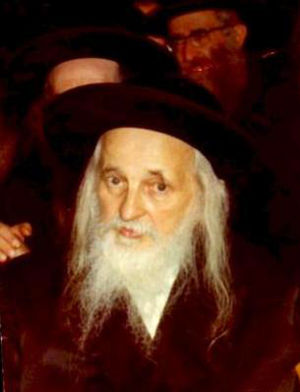 A story ofRav Yoel Teitelbaumהרב יואל בן חנניה יום טוב טייטלבוים
Dr. Ferenz Kennedy, a Hungarian writer who was not a follower of the Rebbe, was on the same transport to Bergen-Belsen and later wrote of what he saw, first in a Yiddish journal in 1959 and in a Hungarian newspaper when the Rebbe visited Eretz Yisroel. He first saw the Rebbe on 2 July 1944 at the Hungarian-Slovakian border, where the train stood for two days as the passengers waited in terror to learn whether they would be sent to Auschwitz. A Jew with a nearly grey beard walked back and forth beside the tracks with both hands inside his white vest, murmuring, like a wounded lion. Someone told Dr. Kennedy that this was the Satmar Rebbe, and that those who were with him had much to be anxious about. The train was finally redirected, with the help of Dr. Kastner, and brought to Bergen-Belsen.
For five months Dr. Kennedy lived in the same block. The Germans themselves allowed the Rebbe to keep his beard, which he hid under a kerchief as if he had a toothache. He did not eat the camp food and lived on water and boiled potatoes, and as far as Dr. Kennedy knew he fasted two or three days a week. His davening and learning could be heard through the barracks nearly all day, in a mournful tune that kept many awake. To Dr. Kennedy it was a plea to Hashem for mercy. The Rebbe was spotless even in the filth of the barracks, and his wife and a young attendant looked after him so that he could continue his service.
Dr. Kennedy won the trust of some SS men through bribes and received newspapers from them, and he shared the news with the barracks each evening. One night the Rebbe's attendant asked him to give the Rebbe the news first, since the Rebbe's bed was far away. Every evening at 6:30 Dr. Kennedy reported to him. The Rebbe listened to the news of Allied victories with calm and said only that great mercy from Heaven was still needed to leave there alive.
On Yom Kippur the Rebbe led Mussaf in their barracks. Dr. Kennedy invited the novelists Bela Zholt and Aladar Komlosh to listen, and both were deeply moved. Dr. Kennedy had once asked the Rebbe's attendant for the Rebbe's autograph, and was told it was not appropriate. In late November, as the passengers waited anxiously for news of release, the attendant asked whether he still wanted it. The Rebbe had not forgotten, and when the time became appropriate, he gave it.
In Switzerland, on a cold December night, the passengers marched through the streets and local Jews tossed apples and sweets to them. All of them asked the same question, “Where is the Rebbe?” Bela Zholt said to Dr. Kennedy, “You see, I am nothing. Hundreds of thousands have read my novels, and no one is waiting for me. They are waiting only for the Rebbe.” Dr. Kennedy later wrote that the Rebbe was without doubt one of the holiest people the Jewish people had produced, and its truest defender of the Torah of Moshe, perhaps too exacting and stubborn in his eyes, but a true leader.